


Elastic Path is the API-first, AI-ready commerce platform for brands with complex requirements: large catalogs, multi-tier pricing, and multiple brands and markets. Manufacturers, distributors, and retailers run account hierarchies, quoting, and negotiated pricing natively, not through bolt-on apps and workarounds.
TL;DR
Top News of the Week: Nike's fiscal 2030 starts in June 2029. That's the first year the company's new five-year plan expects to grow faster than the market, so anyone buying the stock on last week's Investor Day pitch is signing up for two and a half years of waiting.
From Last Week’s News: Ten years ago DICK'S paid for a youth baseball scoring app doing $8M a year. That app will do close to $200M in 2026, and most retail analysts barely mention it.

TOP NEWS OF THE WEEK
Nike Asks Investors To Wait Until 2030
Nike laid out a five-year plan at its Investor Day in Beaverton, Oregon on November 17, and the first year of it is a decline. The company reaffirmed fiscal 2027 guidance for revenue down in the high single digits, operating income falling faster than sales and an adjusted operating margin around 6%.
The strategy is called Full Stride Ahead. On the performance side Nike is concentrating on Running, Training, Global Football, Basketball and Outdoor, and on the lifestyle side on Nike Sportswear, Jordan and Converse, in 23 priority countries. It expects those areas to produce more than 90% of revenue growth through fiscal 2031.

The target for that year is about $5B in added revenue over the fiscal 2027 base, with $4B from Performance Sports and $1B from Sportswear. Nike expects declines to ease in fiscal 2028 and growth to match the market in 2029. Above-market growth isn't in the plan until 2030 and 2031.
By the end of fiscal 2031 the company is aiming for an operating margin of 12% to 14%. A good part of that improvement depends on cost. Nike's Pace program targets roughly $2.5B in annualized savings by fiscal 2031, with most of the ramp in 2029 and 2030, and about $1.3B in pre-tax charges along the way, much of it severance. Savings of that size, set against a $5B revenue goal, suggest the margin target leans heavily on cost saving. Nike didn't publish a bridge between the two, so treat that as my read.
I'm also wary of the Sportswear figure. Lifestyle sneakers powered Nike's last run and then hurt it when Dunks and Air Force 1s were pushed into every channel. Nike now talks about returning Jordan to premium positioning and getting its marketplace healthy again, and a modest $1B target fits a company still working through that hangover.
CFO Dave Denton said "our current financial performance does not yet reflect the full potential of those assets."
The release has no channel split. After years of strategy built around Nike Direct, followed by a move back toward wholesale partners, investors got nothing on how the next $5B divides between retailers and Nike's own stores and apps. Gross margin is described as something to rebuild, with no number attached. Buybacks aren't mentioned, though dividends are, at roughly $12B cumulative from fiscal 2027 through 2031, including about $2.4B this year. Greater China, which used to be the growth story, got a single line saying its reset continues.
THE BIG IDEA
Shareholders are being asked to sit through two and a half down years on dividends and wait for growth to arrive in 2030. That depends on Nike winning back share in running and football over the next three years, and the release names the categories without showing any of the product meant to get there.
THE TRUTH ABOUT LAST WEEK: Fewer Shoppers Went to DICK'S Last Quarter and Spent More When They Did
DICK'S raised $1B in senior notes this quarter and spent $903M buying back 6.7M shares at an average of $134.21. Ed Stack says the market overreacted to short-term problems last quarter, and he bought heavily on that view.
The core business is fine. A 2.6% comp on top of last year's 5.7% is a good result, and management raised the low end of full-year comp guidance to 3.3%. Foot Locker still needs a lot of work.
Average ticket rose 3.7% at DICK'S while transactions fell 1.1%. Management blamed a warm October for weak fleece sales, which may be true, but traffic still went down.
Foot Locker's U.S. banner comped 4.1%. The global business comped 0.5% and lost $40.9M at the operating line, with inventory up 15.8%. Stack expects the cleanup to run through 2027.
GameChanger had about $8M in revenue when DICK'S bought it ten years ago. Management expects close to $200M this year.
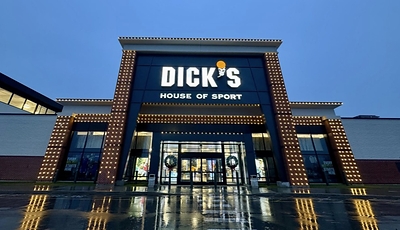
Nike is cutting Jordan allocations, and Stack called that the right long-term decision even though Foot Locker takes the hit first. DICK'S also spent close to a billion dollars on buybacks during the Foot Locker turnaround, and investors don't yet know how much the Jordan reset will cost in 2027.
WHY IT MATTERS
DICK'S is two businesses right now. The DICK'S chain gains share, makes an 8.7% operating margin, and keeps opening House of Sport stores. Foot Locker loses money and holds too much legacy inventory, and the brand it depends on most is cutting its allocation. Management used borrowed money for buybacks because it believes the first business can carry the second through 2027. That might be right.
